
The Historical Roots of Canada-U.S. Friendship
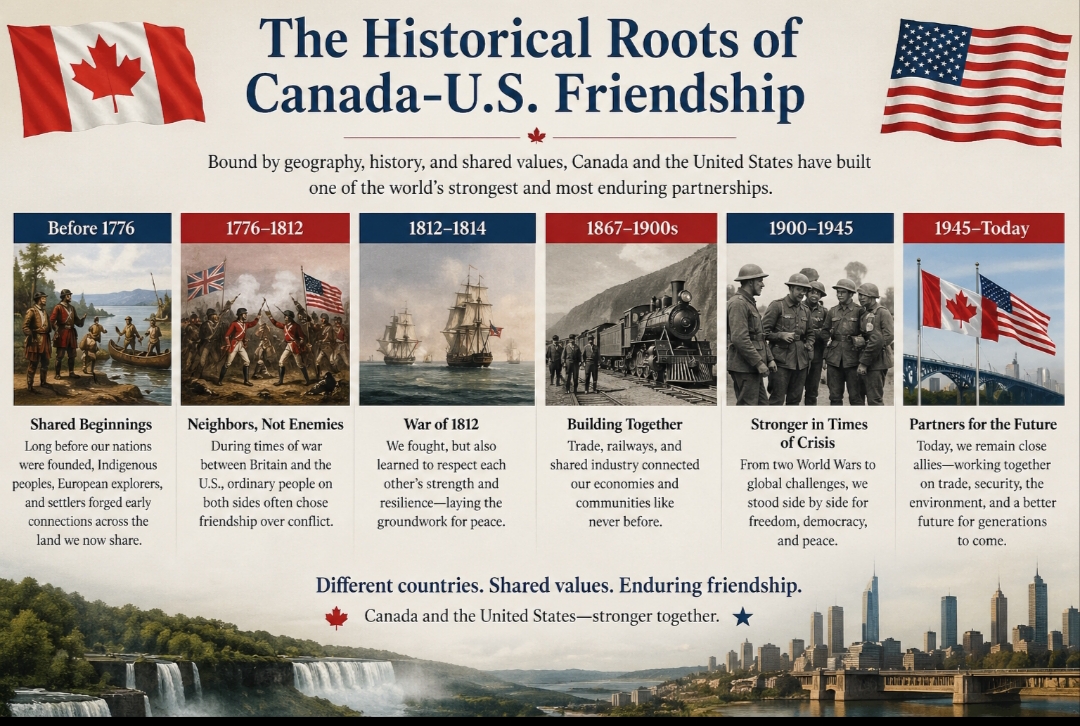
The relationship between Canada and the United States stands as one of the most remarkable examples of peaceful coexistence and deep cooperation between two neighboring sovereign nations in modern history. Sharing the world’s longest international border, these two countries have transformed from occasional adversaries into close allies, economic partners, and cultural neighbors. Geography has placed them side by side, but shared values, mutual interests, and pragmatic diplomacy have forged a enduring friendship that benefits both peoples.
This friendship did not emerge overnight. It evolved through periods of conflict, border disputes, and wary suspicion, gradually giving way to mechanisms for peaceful resolution, economic interdependence, and joint defense. Understanding the historical roots reveals how early tensions laid the groundwork for trust and collaboration that define the bilateral relationship today.
Early Colonial Interactions and Divergent Paths
The foundations of Canada-U.S. relations trace back to the colonial era, when European powers vied for control of North America. French and British colonies in what would become Canada and the Thirteen Colonies to the south frequently clashed over territory, trade, and alliances with Indigenous nations. These colonial wars set patterns of rivalry but also occasional cooperation against common threats.
The American Revolution (1775–1783) marked a pivotal divergence. While the Thirteen Colonies declared independence from Britain, many Loyalists—those remaining faithful to the British Crown—fled northward to British North America, particularly to Nova Scotia, New Brunswick, and Quebec. This influx of settlers strengthened the distinct identity of the northern colonies and sowed seeds of caution toward the new American republic. Some American leaders viewed the conquest of these territories as a natural extension of independence, leading to early incursions.
In 1775, American forces invaded parts of Canada, capturing Montreal briefly but failing to take Quebec City. This episode highlighted the emerging divide: one nation pursuing republican ideals and independence, the other maintaining ties to the British Empire while developing its own character. Despite the setback, cross-border family ties, trade, and migration continued, creating informal bonds even amid political separation.
The Loyalist Influence on Canadian Identity
The arrival of Loyalists profoundly shaped early Canadian society. These migrants brought skills, capital, and a wariness of American expansionism. Their presence reinforced loyalty to British institutions while fostering a distinct North American identity that defined itself partly in contrast to the United States. This “not American” element in Canadian consciousness became a recurring theme, yet it coexisted with extensive people-to-people connections across the border.
The War of 1812: Conflict That Paved the Way for Peace
The War of 1812 represents a critical turning point often described as the last major armed conflict between the two sides. Fought between the United States and the British Empire (including its North American colonies), the war stemmed from maritime disputes, trade restrictions related to the Napoleonic Wars, and American desires to curb British influence and potentially expand territory northward.
American forces launched several invasions into Upper and Lower Canada, expecting support from local populations sympathetic to republicanism. Instead, British regulars, Canadian militia, and Indigenous allies mounted effective defenses. Key battles, such as those at Queenston Heights and Lundy’s Lane, became symbols of resistance in Canadian memory. The war ended in a stalemate with the Treaty of Ghent in 1814, which restored pre-war boundaries without addressing many original grievances.
Legacy of the War of 1812
Far from deepening permanent enmity, the War of 1812 ultimately contributed to the roots of friendship. For Canadians, successful defense against invasion helped foster a nascent national identity and pride in repelling a larger neighbor. For Americans, the conflict reinforced a sense of independence, sometimes called the “Second War of Independence.” Both sides recognized the high costs of continued hostilities along a vast, sparsely populated frontier.
The war’s inconclusive end encouraged pragmatism. Leaders on both sides realized that endless conflict hindered prosperity. This realization accelerated efforts toward demilitarization and peaceful dispute resolution, marking the beginning of a long shift from rivalry to neighborly accommodation.
Post-War Demilitarization and Early Agreements
In the decades following 1815, practical steps reduced the risk of future conflict. The Rush-Bagot Agreement of 1817, one of the world’s earliest arms control pacts, severely limited naval armaments on the Great Lakes and Lake Champlain. This agreement symbolized a commitment to de-escalation in a strategically vital region.
The Convention of 1818 further clarified boundaries westward from Lake of the Woods to the Rocky Mountains along the 49th parallel. These diplomatic successes demonstrated that negotiation could replace force, establishing precedents for resolving territorial disputes without war.
Border Disputes and Their Peaceful Resolution
Subsequent decades saw several flashpoints, including the Aroostook War (a bloodless lumber dispute in Maine-New Brunswick), the Oregon boundary question, and the Alaska Boundary Dispute. Each was settled through diplomacy, such as the Webster-Ashburton Treaty of 1842 and the Oregon Treaty of 1846. The 1908 treaty formally demarcating much of the border, along with the creation of the International Boundary Commission, solidified peaceful management of the frontier.
These resolutions reinforced the concept of the “longest undefended border,” a phrase capturing the mutual trust that replaced fortifications with shared responsibility for maintaining peace. By the late 19th century, permanent military presence along the border had largely vanished, replaced by civilian law enforcement and diplomatic mechanisms.
Economic Ties and Reciprocity Efforts
Economic interdependence formed another pillar of the emerging friendship. Early trade flourished despite political differences, driven by complementary resources and markets. The Reciprocity Treaty of 1854 allowed free trade in many natural products between the United States and the British North American colonies, boosting prosperity until its abrogation in 1866 amid Civil War tensions.
Later attempts at reciprocity, including agreements in the 1930s under leaders like Mackenzie King and Franklin D. Roosevelt, reflected a recurring recognition that open commerce served mutual interests. These efforts laid groundwork for deeper integration in the 20th century.
Canadian Confederation in 1867 created a more unified northern neighbor, yet fears of American annexation or economic dominance persisted in some quarters. Over time, however, practical benefits of partnership outweighed such concerns. Cross-border investment, migration, and supply chains grew steadily.
World Wars and the Forging of Alliance
The 20th century transformed the relationship into a formal alliance. During World War I, Canada entered the conflict as part of the British Empire in 1914, while the United States joined in 1917. Canadian contributions and American industrial might highlighted complementary strengths.
World War II cemented the partnership. Even before Pearl Harbor, Canada and the United States coordinated defense through the Ogdensburg Agreement of 1940, establishing the Permanent Joint Board on Defense. The Hyde Park Declaration further integrated wartime production. Prime Minister William Lyon Mackenzie King and President Franklin D. Roosevelt developed a close personal rapport that symbolized broader cooperation.
Canada declared war on Japan hours after the attack on Pearl Harbor, demonstrating solidarity. Joint efforts in training, manufacturing, and intelligence sharing proved highly effective. Post-war, this wartime alliance evolved into enduring institutions.
Post-War Institutionalization
In 1949, both nations became founding members of the North Atlantic Treaty Organization (NATO), committing to collective defense against emerging threats. The creation of NORAD (North American Aerospace Defense Command) in 1958 formalized binational aerospace defense, a unique arrangement where forces from both countries operate under integrated command.
President Harry Truman captured the spirit of the era by stating that Canada and the United States had reached a point where they could no longer think of each other as “foreign” countries. President John F. Kennedy later echoed this in a 1961 address to the Canadian Parliament: “Geography has made us neighbors. History has made us friends. Economics has made us partners. And necessity has made us allies.”
Shared Values, Culture, and People-to-People Ties
Beyond politics and economics, deep cultural and social connections underpin the friendship. English is the dominant language in much of both countries (with French vital in Canada), facilitating easy exchange. Media, entertainment, sports, and tourism flow freely across the border. Millions of Canadians and Americans trace family roots to the other country, strengthened by historical migration patterns.
Democratic institutions, respect for the rule of law, and commitment to individual rights provide common ground. While differences exist—Canada’s parliamentary system and emphasis on multiculturalism versus the U.S. presidential system and melting-pot traditions—these variations enrich rather than divide.
Environmental cooperation on shared resources, such as the Great Lakes and boundary waters, further illustrates practical partnership through bodies like the International Joint Commission established by the Boundary Waters Treaty of 1909.
Modern Dimensions: Trade, Security, and Challenges
The Canada-U.S. Free Trade Agreement of 1989, followed by NAFTA in 1994 and its successor the United States-Mexico-Canada Agreement (USMCA), created one of the world’s largest trading blocs. Billions in daily cross-border trade support millions of jobs, with integrated supply chains in automobiles, energy, agriculture, and manufacturing.
Security cooperation extends to counterterrorism, border management, and Arctic interests. While occasional disputes arise—over softwood lumber, dairy access, or environmental regulations—both nations resolve them primarily through negotiation and legal mechanisms rather than escalation.
The relationship faces ongoing tests, including differing approaches to certain global issues, but the infrastructure of friendship—diplomatic channels, economic ties, and personal connections—provides resilience.
Conclusion: A Model of Neighborly Relations
The historical roots of Canada-U.S. friendship reveal a journey from colonial rivalry and armed conflict to profound interdependence. Early wars and suspicions gave way to demilitarization, diplomatic innovation, economic partnership, and joint defense born of necessity and shared values.
What began as wary neighbors evolved into the closest of allies, demonstrating that pragmatic cooperation across a long border yields greater security and prosperity than isolation or hostility. As President Kennedy observed, history has indeed made them friends.
This unique bond, symbolized by the longest undefended border, continues to offer lessons for the world: mutual respect, honorable obligations, and a willingness to resolve differences peacefully can transform potential adversaries into steadfast partners. In an uncertain global landscape, the depth of Canada-U.S. ties remains a cornerstone of stability in North America and beyond.